

Thomas LecuitScientist
Institut de biologie du développement de Marseille (IBDM)1
GeoMorpho (Horizon Europe - ERC AdG 101200010)
Geometric constraints and feedback during tissue morphogenesis
During development, cell movements and shape changes give rise to complex 3D forms. What underlies the fidelity of morphogenesis? To date, much emphasis has been placed on understanding how genes and local mechanics drive cell shape changes and tissue scale morphogenesis. However, the roles of the geometric properties of a tissue and its physical boundaries, their size, dimensionality, curvature and overall shape have recently emerged as important yet overlooked features of morphogenesis.
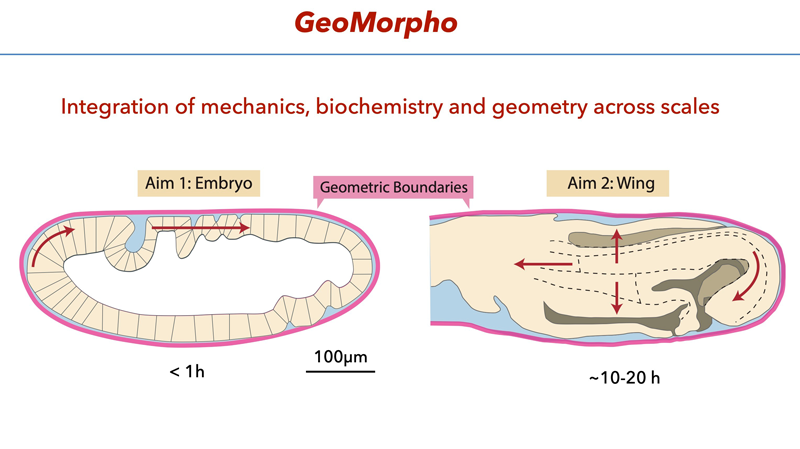
This interdisciplinary project will unravel how geometry and geometric feedbacks constrain lower scale cell mechanics and how they contribute to tissue morphogenesis. We will study the interplay between geometry and active mechanochemical processes in two systems where physical boundaries constrain and guide morphogenesis. In Drosophila embryos, polarized tissue flow and a wave of tissue invagination depend on interactions with the surrounding egg envelope called the vitelline membrane. This envelope imposes tissue curvature, forms a rigid adhesive substrate, and confines the diffusion of molecules within the extra-embryonic fluid.
Likewise, formation of the wing during metamorphosis in the pupa is associated with a dramatic expansion of the tissue surface within a rigid pupal sac forcing a complex tissue packing without compromising flatness in adulthood. The mechanics of tissue flow and expansion are unknown. How flows within these constraints give rise to folding needs to be characterized.
These two systems share key similarities: their dynamics depend on the flow, expansion and folding of tissue layers, and 3D deformations are driven by internal active stresses and external constraints from rigid boundaries. In both cases we will dissect the mechanochemical active processes driving cell and tissue deformations and address how geometrical constraints impact cell and tissue mechanics.
This project will thus reveal how tissue shape affects the processes from which shape emerges.
- 1Aix-Marseille Université/CNRS